


The purpose of our article on the subject is to answer the question of where we are to date in achieving the objective of the Paris Climate Agreement. To understand where we are today, let's look at the subject in its simple form: Climate change was discussed almost two centuries ago, but in concrete terms, Arrhenius, 1896, was the first to point out that changes in the levels of carbon dioxide CO2 in the atmosphere could alter the temperature of the planet; later, in 1938, Callendar spoke of the increase in CO2 in the atmosphere as a cause of global warming. We can understand that since then a whole series of debates have followed on the subject.
On September 16, 1987, a protocol agreement between about 46 countries was born in Montreal, Canada, to take measures on substances that tend to deplete the ozone layer; we know such an agreement by the famous name of Montreal Protocol; the signatories agreed to limit or stop producing substances that deplete the ozone layer. On May 9, 1992, in New York, USA, under the auspices of the United Nations, a convention was reached, whose adoption would enter into force on March 21, 1994, with 165 signatories who agreed to address climate change; the convention called the UN Framework Convention on Climate Change (UNFCCC) adopted a structure for annual meetings called the Conference of the Parties (COP) where they will have to look in depth at how they can combat the concentration of greenhouse gases in the atmosphere.
On December 11, 1997, in Kyoto, Japan, a treaty known as the Kyoto Protocol, which would enter into force on February 16, 2005, was adopted by 192 Parties who formally agreed on targets for reducing greenhouse gases in the atmosphere through market-based mechanisms. The Kyoto Protocol, or UN Climate Change Conference (COP3), is the result of the meetings that have continued since the UNFCCC agreement. And on December 12, 2015, the Paris Agreement, which would enter into force on November 4, 2016, was born and officially replaced the Kyoto Protocol. The former is the most comprehensive in the sense that it recognizes climate change as a common problem that should be taken into account by all countries, while the latter only concerned developed countries with regard to their greenhouse gas emissions in the atmosphere (ref).
In fact, the Paris Agreement remains to date the largest treaty of nations on climate change, but with a bit of contradictory apprehension and divergence of the signatory actors. First, within the scientific community that maintains that human activities - the use of fossil fuels - are mainly at the root of global warming, there are divergent views on the approaches to adopt to achieve the reduction of the expected CO2 level by 2030 and net zero by 2050 (ref). The points of view of scientists in this case are not worth it since they do not have decision-making power. On the other hand, decision-makers or signatories who are supported by some scientists are very pessimistic about the postulates that human activities are mainly at the root of climate change; a practical case of this is the abandonment of the Paris Agreement by the American government for two times during the two terms of President Donald Trump.
To this last point are added the non-industrialized countries who think that they are not polluters emitting greenhouse gases on a large scale in the atmosphere and, in fact, they are not too concerned. However, if it is true that all the major world space agencies -NASA, CNSA, ROSCOSMOS, ESA, etc.- have agreed on the subject that global warming is mainly due to human activities, each country must assume its responsibilities and fight for a healthy planet; different countries, one planet, that said, what happens in one country can have consequences on another or others. On such an idea, non-industrialized countries or at least undeveloped countries think rather that they are victims of industrialized giants who are at the top of the list of the largest emitters of greenhouse gases in the atmosphere.
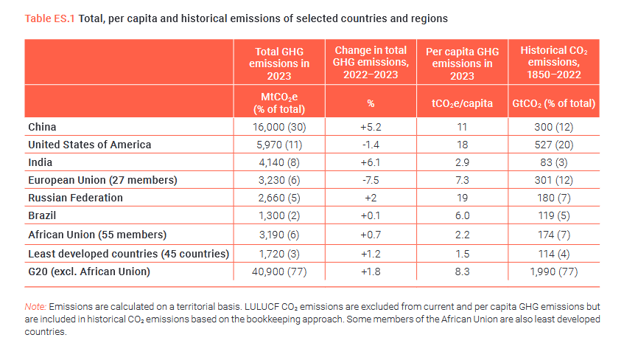
Source: UN Emissions Gap Report 2024, p. XII
If the top 20 largest economies in the world, known as the G20, are responsible for 77% of greenhouse gas emissions in the atmosphere, with 6 countries alone accounting for 63%, undeveloped countries or at least subsistence economies should think that they are victims, knowing that according to the UN, 45 least developed countries account for 3%. Considering the above ranking, the major emitters of greenhouse gases in the atmosphere should act more responsibly by reviewing their energy matrix, their transportation sector, their manufacturing sector, etc., and help undeveloped countries adopt solutions adapted to their needs. What has somehow entered into the guiding framework of the Paris Agreement, in fact, the ball to stabilize the level of carbon dioxide in the atmosphere and allow a healthy planet is in the court of the so-called industrialized countries.
The Montreal Agreement that we mentioned above was fruitful, that said, with a little determination, the countries emitting CO2 on a large scale can achieve a reduction in their emission level. However, to date, there is no sign that the targeted goals to achieve a reduction of emissions to 43% by 2030 and to reach net zero by 2050 as recognized by the United Nations itself. Furthermore, the withdrawal of the United States, the second largest emitter of CO2 in the atmosphere after China, from the Paris Agreement is a severe blow that tends to block the path towards achieving the goals of the said agreement, alongside the reluctance of an important player, Iran, to formally embark on it. Despite their choice, each nation should continue to work to remain in line with the Nationally Determined Contributions (NDCs) of the Paris Agreement.