Why the Russia-Ukraine War Defies a Classic Victory

Introduction: The Illusion of a Clean Sweep

In the age of modern, 24-hour news cycles and competing political narratives, major international conflicts are often packaged into a binary framework: one side is winning, and the other is losing. The West frequently projects a narrative of imminent Ukrainian triumph, pointing to tactical resilience and long-range strikes. Conversely, Moscow frames its relentless, grinding advances in Eastern Ukraine as proof of an inevitable victory.

Objectively analyzing the material, economic, and human structural data reveals that both perspectives fall victim to propaganda. The war between Russia and Ukraine has evolved into a classic war of attrition. It is a conflict where the traditional concept of a winner, one army decisively routing the other to dictate absolute terms, is mathematically and militarily highly improbable for either side.

Instead, the conflict is hurtling toward a conclusion defined by mutual exhaustion, localized strategic victories, and permanent domestic scars.

1. The Realities and Limits of the Russian War Machine

To analyze the conflict objectively, one must look directly at what Russia has achieved, what it has sacrificed, and what it is fundamentally incapable of doing.

The Truth About Territorial Creep

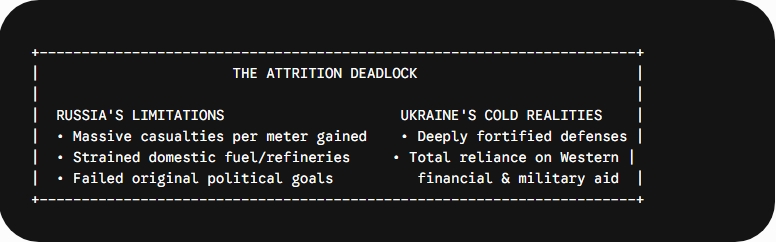
Russia has successfully mobilized its economy for a long-term war, but its military progress on the ground is microscopic compared to its original 2022 objective of total subjugation. Russian forces continue to make slow, incremental gains in the Donbas, creeping forward daily through heavily fortified Ukrainian defensive lines. However, this progress is measured in meters, not kilometers. To secure minor tactical footholds, Russia is burning through older Soviet armor reserves and taking immense casualties, rendering its advances a grueling tactical crawl rather than a sweeping conquest.

The Scale of Domestic Resilience vs. Local Friction

As a vast superpower spanning eleven time zones, Russia possesses a massive domestic supply chain and some of the world's deepest natural resource reserves. Minor localized disruptions cannot break the Russian state. However, Ukraine's asymmetric strategy of targeting Russia's domestic oil infrastructure with long-range drone strikes has created measurable economic friction. By systematically hitting major refineries deep within Russian territory, Ukraine has exposed vulnerabilities in Russia's air defense networks and forced domestic fuel restrictions in several regions. It does not cripple the Kremlin's war machine, but it forces Moscow to continuously reallocate defenses and financial capital away from the front lines.

2. The Asymmetry and Limits of the Ukrainian Defense

Ukraine’s resistance is a historic feat of military adaptation, yet its path to a total battlefield victory faces immense structural barriers.

The Attrition Deadlock

The Defensive Wall

Ukraine has successfully utilized advanced drone technology, intelligence sharing, and Western air defense systems to prevent Russia from establishing air superiority or achieving major territorial breakthroughs. However, changing the map is entirely different from holding the line. Pushing a heavily dug-in, deeply fortified Russian army completely out of the Donbas and Crimea requires an offensive capability, mass manpower, and air power that Ukraine does not possess in sufficient quantities.

The Geopolitical Straw

Ukraine is a nation of roughly 38 million fighting a neighbor with over 140 million. Ukraine’s survival is almost entirely tied to the political and economic predictability of its Western allies. Fluctuations in foreign aid packages, political shifts in Washington or European capitals, and delays in ammunition deliveries mean that Ukraine is fighting with a structural vulnerability. They have enough support to prevent a total defeat, but rarely enough to launch a decisive, war-ending counteroffensive.

3. Redefining Victory: Tactical vs. Strategic Outcomes

Because a clean military breakthrough is blocked by the material realities on the ground, the eventual conclusion of the war requires separating tactical success from big-picture strategy.

Why Ukraine Can Claim a Strategic Victory

If the definition of a winner is based on a nation defending its existential right to exist against a global superpower, Ukraine will emerge as the strategic victor. Russia's grand political objective was to erase Ukrainian independence and pull it back into Moscow's sphere of influence. That objective has definitively failed. When the major fighting eventually stops, Ukraine will remain a sovereign, independent state with a battle-hardened military, deeply integrated into Western security and economic frameworks. For a smaller neighbor to survive a full-scale invasion by a nuclear superpower is a profound historic victory.

Why Russia Faces a Hollowed-Out Outcome

Conversely, even if Russia successfully uses its mass to hold onto captured territories in the east, that tactical win comes at a catastrophic strategic price. Russia will have sacrificed hundreds of thousands of lives, emptied its sovereign wealth funds, crippled its long-term technological development under Western sanctions, and permanently pushed its European energy customers away all to govern a heavily mined, destroyed, and deeply hostile borderland.

Conclusion: The Unfinished Peace

Wars do not have to last forever, but history proves they rarely end cleanly. The structural gridlock between Russia and Ukraine points directly toward an eventual frozen conflict, reminiscent of the Korean Peninsula or Cyprus.

The war will likely conclude when both nations hit a wall of human and economic unsustainability. The ending will not feature a grand surrender ceremony. Instead, it will likely manifest as a heavily negotiated, bitter ceasefire born out of mutual exhaustion.

The lines on the map will freeze where the soldiers stand. Russia will hold territory it has taken by force, a claim the international community will never legally validate. Ukraine will preserve its independent capital, its core population, and its future path toward the West. It is an outcome devoid of triumph, a pragmatic, scarred peace where victory is measured not by how thoroughly you crushed your enemy, but by how much of your nation you managed to save.